
The Woman in Black
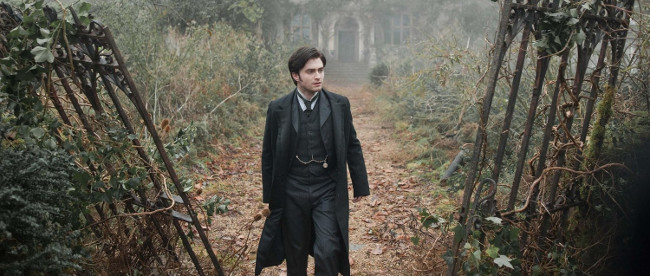
Based on the novel by Susan Hill, The Woman in Black follows Daniel Radcliffe’s Arthur Kipps, an early 20th-century lawyer, as he arrives in a small village intending to settle the estate of a recently-deceased individual – with problems ensuing as it becomes increasingly clear that a malicious, malevolent ghost is haunting said estate. It’s a decidedly conventional premise that is, at the outset, employed to promising effect by director James Watkins, as the filmmaker, working from Jane Goldman’s script, opens the proceedings with a striking pre-credits sequence that immediately sets a tone of low-key eeriness. It goes without saying, then, that the familiarity of what follows is initially not as problematic as one might’ve feared, with the ongoing emphasis on Radcliffe’s character’s deliberately-paced exploits – eg Arthur must contend with several suspicious villagers, Arthur explores the creaky old house, etc, etc – generally allayed by Watkins’ solid directorial choices and the periodic inclusion of creepy images and interludes (eg Arthur is confronted by a little girl who’s just swallowed some lye). There does reach a point, however, at which the repetitive nature of the narrative becomes impossible to comfortably stomach, as much of the movie’s midsection is devoted to one scene after another of Arthur’s investigation into the spooky happenings within the house. It’s inherently tedious stuff that only grows more and more problematic as time progresses, with the increasingly oppressive atmosphere dulling the impact of the film’s climactic revelations and ensuring that The Woman in Black ultimately overstays its welcome to a distressingly demonstrable degree.
** out of ****
Leave a comment
You must be logged in to post a comment.