
Suffragette
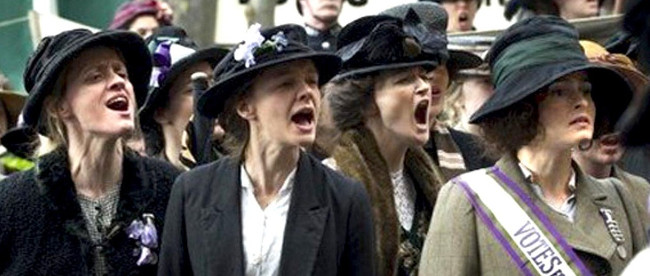
An astonishingly tedious drama, Suffragette details the true-life efforts of several figures to bring the vote to women in the early 20th century – with the film singling out one such individual (Carey Mulligan’s Maud Watts) and her transformation from dutiful mother and wife to rebellious foot soldier in the fight for equality. It’s a compelling premise that certainly could (and should) have been employed to superb effect, and yet there’s little doubt that director Sarah Gavron and scripter Abi Morgan remain unable to capture the viewer’s interest for the duration of Suffragette‘s often interminable running time. Ranking high on the movie’s list of problems is a visual sensibility that’s nothing short of disastrous, as cinematographer Eduard Grau offers up a drab, unpleasant look that effectively perpetuates the palpably lifeless feel. Morgan’s less-than-subtle screenplay hardly does Suffragette any favors, with the writer’s hit-you-over-the-head approach dulling the impact of the movie’s few heartwrenching moments and essentially cultivating an atmosphere of high melodrama. It’s clear, too, that Mulligan’s dour performance does nothing to alleviate the pervasively inert production, while the big, crowd-pleasing developments of the movie’s final few minutes fall absolutely and utterly flat – thus securing Suffragette‘s place as a well-intentioned yet hopelessly (and aggressively) uninvolving piece of work.
*1/2 out of ****
Leave a comment
You must be logged in to post a comment.