
Rachel Getting Married
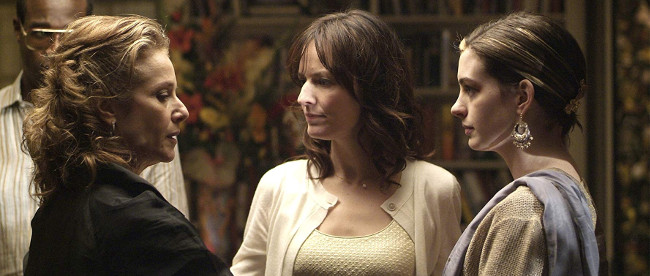
Infused with a pervadingly experimental vibe, Rachel Getting Married can’t help but come off as an alternatingly intriguing and maddening cinematic experience – as director Jonathan Demme’s unconscionably second-rate visuals often hinder one’s efforts at wholeheartedly embracing the movie’s well-defined characters. Anne Hathaway stars as Kym, a spunky troublemaker who arrives at her family’s country home for the wedding of her older sister (Rosemarie DeWitt’s Rachel) following a stint at rehab – with the bulk of the film subsequently revolving around the various matrimonial preparations and traditions that ensue. Demme’s efforts at replicating the look and tone of a fly-on-the-wall documentary immediately proves effective at alienating the viewer, as the filmmaker consistently stresses self-consciously low-rent elements that ultimately lend the proceedings the feel of a garden-variety home movie. The inclusion of several mind-numbingly tedious episodes perpetuates scripter Jenny Lumet’s arm’s-length modus operandi, with a sequence detailing the pre-wedding speeches from Rachel’s family and friends – occurring in what feels like real time – undoubtedly the most apt (and downright frustrating) example of this. There does reach a point, however, at which the characters – assisted by the uniformly superb performances – start to grow on the viewer, with the emphasis on increasingly compelling individual interludes (ie Kym delivers a tearful speech to her fellow addicts, two characters engage in a dishwasher-filling competition, etc) playing an instrumental role in the film’s eventual about face. Demme almost blows the relatively engrossing ambiance by spending far too much time on the post-nuptials celebration – ie Rachel Getting Married briefly threatens to morph into the Shortbus of wedding movies – yet it’s hard to deny the effectiveness of the film’s closing minutes. The final result is an endeavor that’s sporadically quite entertaining in spite of its shoddy production values and egregiously avant-garde sensibilities, and it’s certainly quite clear that the movie would’ve benefited substantially from a more mainstream approach.
**1/2 out of ****
Leave a comment
You must be logged in to post a comment.