
Pontypool
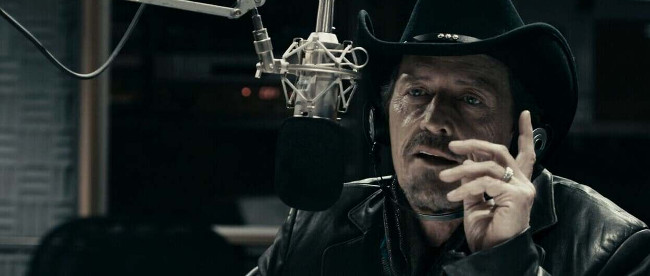
There’s little doubt that Pontypool is ultimately undone by its increasingly outlandish premise, which is certainly a shame given the effectiveness of Bruce McDonald’s ominous directorial choices and Stephen McHattie’s consistently compelling performance. The movie, which transpires primarily within the cramped confines of a church/radio station, details the chaos that ensues after an inexplicable virus takes hold of a small town, with the bulk of the proceedings revolving around disc jockey Grant Mazzy’s (Stephen McHattie) efforts at broadcasting live updates and figuring out precisely what’s happened. It’s a promising set-up that’s initially employed to unexpectedly positive effect by McDonald, as the filmmaker effectively (yet temporarily, surely) eschews his avant-garde sensibilities in favor of an appealingly old-school approach – thus ensuring that Pontypool often bears more than a passing resemblance to its various thematically-similar predecessors (eg John Carpenter’s Assault on Precinct 13). The inclusion of several shockingly horrific interludes only cements the movie’s early success, though it’s difficult to downplay the strength of McHattie’s charismatic, flat-out engrossing work as the progressively frazzled central character. It’s only as the markedly abstruse elements within Tony Burgess’ screenplay become more and more prominent that one’s interest begins to dwindle, as the eye-rollingly outré rationale behind the outbreak is just impossible to swallow (and almost entirely nonsensical to boot). There’s no denying that Pontypool subsequently loses its momentum somewhere around the one-hour mark and essentially limps to its anti-climactic conclusion, which ensures that one is finally forced to label the movie a promising yet thoroughly irrelevant horror effort.
** out of ****
Leave a comment
You must be logged in to post a comment.