
Lockout
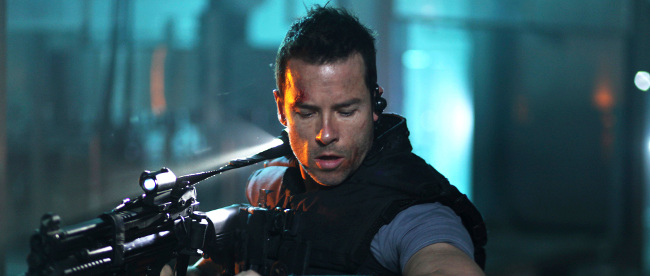
Despite the seemingly can’t-miss nature of its premise (the film is, after all, essentially Die Hard on a space station), Lockout is simply unable to become the fun and fast-paced thriller that its creators have clearly intended – as the movie suffers from a pervasively uneven sensibility that slowly-but-surely drains the viewer’s enthusiasm and renders its overtly positive attributes moot. The genre-friendly storyline follows rugged antihero Snow (Guy Pearce) as he reluctantly attempts to rescue the president’s daughter (Maggie Grace’s Emilie) from a space station full of violent inmates, with the film subsequently (and primarily) detailing the game of cat-and-mouse that ensues between the protagonists and their blood-thirsty pursuers. There’s little doubt that Lockout gets off to a nigh disastrous start, as filmmakers James Mather and Stephen St. Leger open the proceedings with an astonishingly incoherent action sequence that’s immediately followed by a car chase rife with laughable special effects (ie the sequence looks like something out of a 10-year-old video game). It’s just as clear, however, that the film does improve demonstrably once the high-concept premise kicks into gear, with the irresistibly tongue-in-cheek atmosphere heightened by Pearce’s magnetic turn as the sardonic central character. The increasingly meandering midsection, which seems devoted primarily to Snow and Emilie’s efforts at finding their way off the aforementioned station, inevitably wreaks havoc on the movie’s tenuous momentum, and it does, as a result, become harder and harder to work up any real interest in the heroes’ ongoing exploits. (It doesn’t help, either, that Mather and St. Leger have infused the proceedings with a murky visual sensibility that grows increasingly oppressive as time progresses.) By the time the rushed and hopelessly anticlimactic finale rolls around, Lockout has effectively squandered the goodwill engendered by its inherently captivating setup – which is a shame, really, given the strength of several key sequences and of Pearce’s continually engrossing performance.
** out of ****
Leave a comment
You must be logged in to post a comment.