
Hysteria
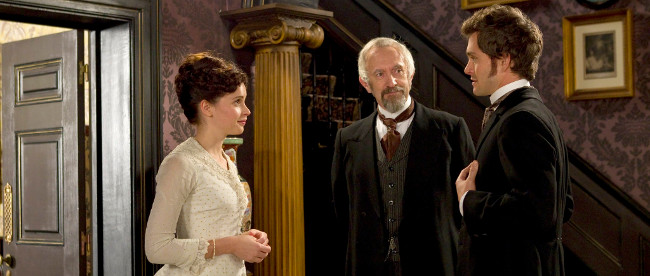
Hysteria follows 18th century doctor Mortimer Granville (Hugh Dancy) as he accepts a position with a physician (Jonathan Pryce’s Robert Dalrymple) renown for his questionable treatment of female hysteria (ie he pleasures his patients with his right hand), with the movie detailing Mortimer’s ongoing efforts at adjusting to the demands of the job and winning over the various patients. (Mortimer must also contend with his boss’ two very different daughters, Felicity Jones’ sweet Emily and Maggie Gyllenhaal’s fiery Charlotte.) There’s little doubt that Hysteria, despite the seemingly can’t-miss nature of its premise, is never quite able to wholeheartedly capture the viewer’s attention or interest, as filmmaker Tanya Wexler, working from Stephen Dyer and Jonah Lisa Dyer’s almost aggressively light-hearted screenplay, has infused the proceedings with a sluggish feel that slowly-but-surely cancels out its positive attributes (including the charming performances and impressive period design and costumes). The inherently compelling nature of Dalrymple’s “treatment” is often eschewed in favor of the melodramatic (and hopelessly dull) exploits of the various characters, with, especially, the tedious arc of Gyllenhaal’s Charlotte, which culminates in an entirely anticlimactic courtroom sequence, ranking high on the film’s list of misbegotten attributes. The pervasively uninvolving atmosphere, which only grows more and more pronounced as time progresses, proves effective at transforming Hysteria into a seriously interminable piece of work, and there’s ultimately little doubt that the movie would’ve been hard-pressed to justify its existence even as a 15-minute short.
*1/2 out of ****
Leave a comment
You must be logged in to post a comment.