
Gladiator
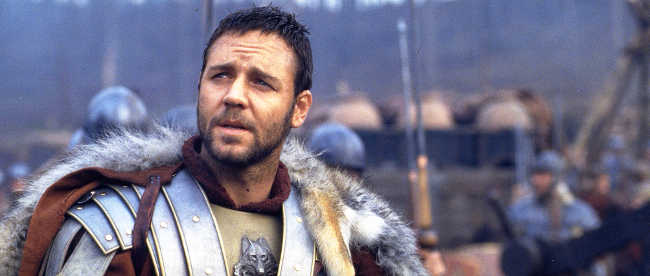
Directed by Ridley Scott, Gladiator follows a Roman general (Russell Crowe’s Maximus) as he’s betrayed by his new emperor (Joaquin Phoenix’s Commodus) and forced into slavery. There’s little doubt that Gladiator doesn’t begin with much in the way of promise or entertainment value, as filmmaker Scott, armed with a script by David Franzoni, John Logan, and William Nicholson, kicks the proceedings off with a far-from-engrossing battle sequence that couldn’t possibly be less appealing or more tiresome – with the arms-length atmosphere perpetuated by the entirely (and aggressively) underwhelming visuals (ie enough with the choppy slow motion, already). It’s clear, then, that the picture slowly-but-surely improves once it progresses into an increasingly compelling and engaging midsection, and although the ongoing emphasis on the period’s political happenings is rarely, if ever, as enthralling as Scott has intended, Gladiator benefits from a second half that is, given its focus on Maximus’ vengeance-fueled exploits, virtually overflowing with spellbinding interludes (eg Maximus reveals himself to Commodus, Maximus finds himself confronted by vicious tigers, etc) – with the first-class vibe enhanced and perpetuated by Crowe’s mesmerizing turn as the entirely sympathetic protagonist and Phoenix’s deliciously smarmy portrayal of the almost comically evil Commodus. (It doesn’t hurt, either, that Scott has elicited top-notch work from periphery players like Oliver Reed, Connie Nielsen, and Derek Jacobi.) By the time the incredibly satisfying (and unexpectedly moving) climax rolls around, Gladiator has cemented its place as a top-tier historical epic that contains its fair share of powerful and downright iconic scenes and images. (It’s just too bad about that first act, though.)
***1/2 out of ****
Leave a comment
You must be logged in to post a comment.