
Force Majeure
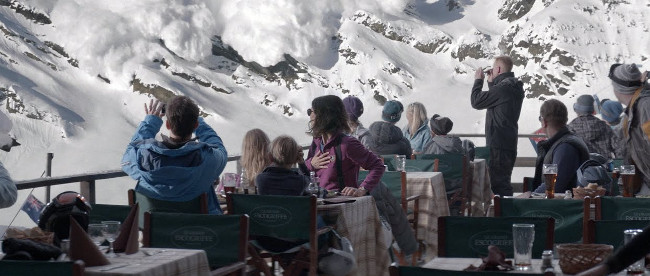
Force Majeure follows a family of four – dad Tomas (Johannes Kuhnke), mom Ebba (Lisa Loven Kongsli), and kids Vera (Clara Wettergren) and Harry (Vincent Wettergren) – as they arrive at the French Alps for a ski holiday, with problems ensuing after Tomas reacts in a less-than-heroic manner to what looks like a deadly avalanche. Filmmaker Ruben Östlund does a superb job of immediately luring the viewer into the deliberately-paced proceedings, as the writer/director has infused Force Majeure with a striking visual sensibility that proves hypnotic from the word go (ie Östlund’s penchant for long, unbroken takes is generally nothing short of electrifying). The film’s domestic-drama atmosphere initially holds a great deal of promise, too, as Östlund effectively establishes the four central characters and their relatively comfortable dynamic with one another. It’s clear, of course, that the movie’s trajectory changes dramatically in the wake of that aforementioned avalanche scare, with Östlund’s decision to force the characters to almost immediately confront the issue ensuring that Force Majeure retains a plausible vibe from beginning to end. (Contrast the characters’ openness with the curiously, bafflingly closed-off manner in which the protagonists deal with a similar situation in Julia Loktev’s The Loneliest Planet.) There’s little doubt, however, that the film begins to wear out its welcome as it passes its midway point, as Östlund suffuses the narrative with a whole host of palpably padded-out elements that diminish the film’s overall impact. (What are we to make, for example, of Tomas’ brief visit to a homosexual rave?) And although Östlund offers up a fairly affecting final stretch, Force Majeure‘s oddball, inexplicable finale ultimately confirms its place as a sporadically engrossing yet perpetually erratic familial drama.
**1/2 out of ****
Leave a comment
You must be logged in to post a comment.