
Django Unchained
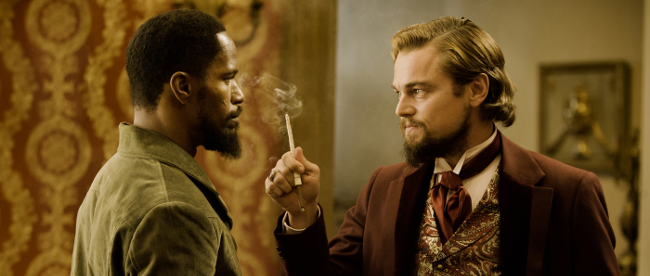
At more than two-and-a-half hours, Django Unchained ultimately establishes itself as Quentin Tarantino’s most uneven endeavor to date – with the impressively engrossing first half giving way to an erratically-paced latter stretch that’s rife with padded-out and needless sequences. It’s clear, however, that the film, which follows a recently-freed slave (Jamie Foxx’s Django) as he attempts to rescue his wife (Kerry Washington’s Broomhilda) from a plantation owner (Leonardo DiCaprio’s Calvin Candie), remains compulsively watchable for the majority of its (admittedly overlong) running time, as Tarantino, as expected, does an astounding job of packing the narrative with spellbinding interludes and memorable characters. (There is, for instance, a captivating early scene in which Django and his partner, Christoph Waltz’s King Schultz, effectively explain their rationale for murdering a beloved sheriff to an angry mob.) The stirring atmosphere is heightened by Tarantino’s eye-catching visual choices and the uniformly impressive performances, with, in terms of the latter, Waltz’s scene-stealing turn standing as an early highlight in the proceedings. (DiCaprio’s character doesn’t show up until around the midway point and it’s immediately clear that the actor, who delivers what is perhaps the most gleefully broad performance of his career, is relishing every second of his screen time.) There reaches a very specific point – Django and Schultz arrive at Candie’s opulent estate – wherein Django Unchained begins to lose its iron grip on the viewer, as Tarantino offers up a handful of sequences that overstay their welcome to an increasingly demonstrable degree (eg Candie threatens one of his slaves with a dog mauling) – with the less-than-consistent vibe generally allayed by the inclusion of palpably enthralling moments (like, for example, Candie’s showstopping speech on phrenology). (It doesn’t hurt, either, that the climactic stretch of the film contains both a gloriously violent shootout and a crowdpleasing finale.) The end result is a typically offbeat piece of work from an unapologetically irreverent filmmaker, with the movie’s rough-cut feel, for the most part, rendered moot by Tarantino’s pervasively engaging sensibilities.
***1/2 out of ****
Leave a comment
You must be logged in to post a comment.