
Carol
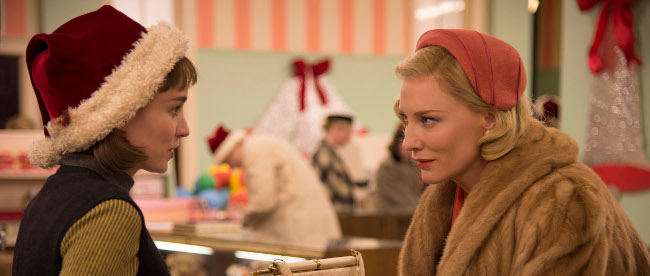
Based on a novel by Patricia Highsmith, Carol follows ’50s department-store clerk Therese (Rooney Mara) as she falls for a married high-society figure named Carol (Cate Blanchett) – with the movie detailing the various complications that subsequently (and naturally) ensue (including Carol’s ongoing dealings with her estranged husband, Kyle Chandler’s Harge). Filmmaker Todd Haynes, working from Phyllis Nagy’s script, has infused the entirety of Carol with an almost excessively slow-moving pace that is, in the movie’s first half, nothing short of disastrous, as the viewer’s initial attempts at embracing the characters are stymied by Haynes’ overly deliberate approach to the material. There is, as a result, little here to wholeheartedly embrace in the film’s early stages, with the strong performances and flawless production design unable to compensate for a narrative lacking in compelling, attention-grabbing attributes. (The film is, at the outset, quite appealing to look at it but there’s just no emotional resonance here.) Carol improves demonstrably once Therese and Carol embark on a road trip to Chicago, as the storyline finally adopts some dramatic heft that’s otherwise been entirely absent from the proceedings – with the movie’s second half subsequently boasting an impressive number of electrifying sequences (eg Carol undergoes a fairly traumatic legal deposition). There finally does, then, reach a point wherein the viewer becomes invested in the clandestine relationship between Mara and Blanchett’s respective characters, with this, in turn, ensuring that the movie’s final stretch packs a far more emotional punch than one might’ve anticipated – which ultimately does compensate for the ineffectiveness of Carol‘s opening stretch and confirms the movie’s place as an erratic yet heartwrenching period piece.
*** out of ****
Leave a comment
You must be logged in to post a comment.