
Tron: Legacy
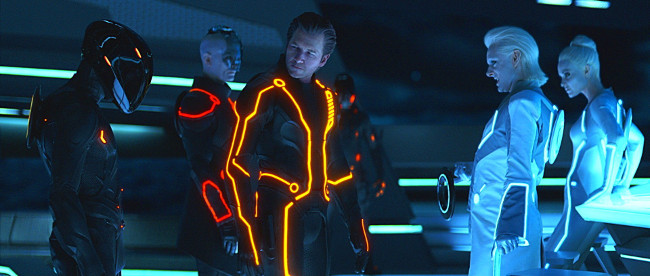
An undeniable improvement over its lackluster predecessor, Tron: Legacy picks up two decades after the events of the original and follows Garrett Hedlund’s Sam Flynn as he ventures into an expansive virtual world to rescue his father (Jeff Bridges’ Kevin Flynn) – with Sam’s ongoing efforts hindered by the presence of his pop’s much-younger digital doppelganger (Bridges’ Clu). Director Joseph Kosinski, working from Edward Kitsis and Adam Horowitz’s screenplay, certainly does an effective job of initially capturing the viewer’s attention and interest, as the filmmaker has infused the movie’s real-world sequences with an entertaining and frequently exhilarating sensibility that’s heightened by Daft Punk’s consistently captivating score. There’s little doubt, however, that the palpable momentum of Tron: Legacy‘s opening half hour comes to a dead stop once Sam enters the series’ infamous Grid, with the pervasive lack of context – ie what is the Grid, exactly? – resulting in an eye-popping yet hollow atmosphere that is, for the most part, almost aggressively meaningless. The less-than-engrossing vibe is exacerbated by a dearth of wholeheartedly compelling characters – Olivia Wilde’s scrappy sidekick Quorra is a notable exception – with Kosinsky’s decision to offer up a fully computer-animated, de-aged version of Bridges’ Clu nothing short of disastrous (ie Clu, fake-looking and waxy, feels like a reject from a Zemeckis film). It’s not until the anticipated light cycle chase that Tron: Legacy finally becomes more than just a mildly watchable thriller, as the scene, accompanied by Daft Punk’s pounding score, infuses the movie with a burst of much-needed energy and effectively compensates for the almost total absence of substantive elements. (This is a pattern that holds for the remainder of the proceedings, with the film subsequently possessing an equal number of propulsive action sequences and dull, disappointingly lifeless dialogue-based moments.) The final result is a breathtaking special-effects extravaganza that generally manages to outdo its big-budget cinematic brethren in terms of excitement and audaciousness, yet it’s ultimately impossible not wish that the filmmakers had devoted just as much attention to the movie’s characters and story as they clearly did to its visuals. (And let’s not even get started on the headache-inducing, utterly needless use of 3-D.)
*** out of ****
Leave a comment
You must be logged in to post a comment.