
Agora
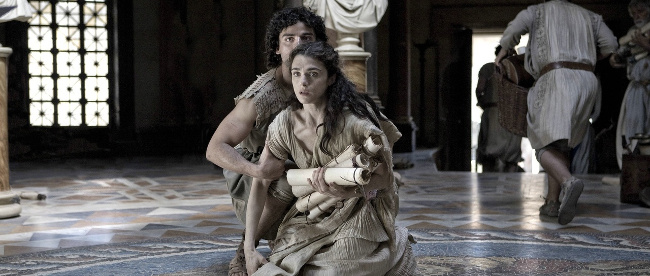
Agora documents the life of Greek professor and scholar Hypatia (Rachel Weisz) against the backdrop of Christianity’s rise within 4th century Alexandria, with the bulk of the proceedings following Hypatia’s friends and colleagues as they deal with the tumultuous changes in radically different ways (eg some convert while others choose to fight). Filmmaker Alejandro Amenábar, working from a script cowritten with Mateo Gil, has infused Agora with an unapologetically old-fashioned sensibility that’s clearly meant to evoke the larger-than-life epics of yore, although the emphasis on countless underwhelming elements ensures that the movie remains terminally uninvolving virtually from start to finish. Ranking high on the film’s list of deficiencies is its almost total lack of compelling figures; Weisz’s admittedly sympathetic turn as Hypatia aside, Agora boasts as unappealing a selection of supporting characters as one could possibly envision and there’s little doubt that it becomes increasingly difficult to work up any enthusiasm for their respective endeavors. Amenábar’s sweeping directorial choices are consistently undermined by the pervasively artificial atmosphere, as the movie primarily transpires on expensive sets that look like expensive sets – with the less-than-authentic vibe ultimately exacerbated by the screenplay’s relentlessly overwrought nature (ie the interplay between certain characters smacks of high melodrama). The ongoing absence of momentum within the narrative ensures that Agora becomes more and more tedious as it unfolds, with the tragic conclusion subsequently unable to pack the emotional punch that Amenábar is clearly striving for – thus cementing the movie’s place as a misguided and utterly forgettable piece of work.
* out of ****
Leave a comment
You must be logged in to post a comment.